
We spoke with Alessandro Milozzi, CEO and Co-Founder of Neuronova and a mentor at TEF Ignition, about transforming cutting-edge neuromorphic research into the world’s most energy-efficient AI processor.
He shares how a young, ambitious team in Milan is bringing intelligence to everyday devices and the lessons learned launching a deep-tech startup. From early challenges to practical advice for aspiring founders, this conversation shows how ideas become impact.
How many people are there in the Neuronova team, and what is the average age?
“The team currently consists of nine people (three founders and six employees) as well as an advisory board made up of four other people. The average age of the team is 27, something we are very proud of, as Neuronova aims to be both a space in Italy where highly specific deep tech skills can be focused, and a space where people can grow and fully express their potential.”
Can you tell us, in a few words, who the founders of Neuronova are and how you met?
“We are three engineers with PhDs in different areas of neuromorphic computing, the paradigm behind our technology, which emulates the functioning of the biological brain to create much more powerful and capable artificial intelligence processors. Although this field is currently experiencing strong growth, in recent years it was still very small, and we all knew each other to some extent among the various research groups: I encountered Michele through Professor Ferrari of the Politecnico di Milano, and with Marco through a discussion forum on Discord.”
Where did the idea that led to the founding of Neuronova come from?
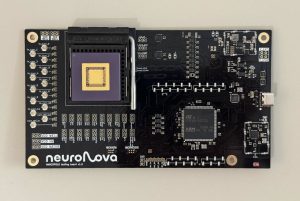
“Neuronova’s idea is based on two fundamental pillars: technology and people. On the technology side, we focus on neuromorphic computing, a revolutionary approach pioneered in the late 1980s by Carver Mead’s group to emulate the human brain, the most capable and efficient machine. While AI has recently flourished through software on standard processors, a critical gap remains: there are few hardware platforms capable of supporting truly conscious AI that is energy-efficient, scalable, and sustainable. Neuronova addresses this by developing the world’s lowest-power neuromorphic processor, drawing on 30 years of research and proprietary technology with a clear market and technological vision.
The second pillar is people. We chose to build Neuronova in Italy to show that human talent drives profound innovation. Our country is full of extraordinary skills, yet many individuals lack platforms to realize their potential, often moving abroad or switching fields. Neuronova aims to be one of those platforms, a focal point where talent and ambition converge, proving that even from Italy, innovation can have global impact.”
If you had to describe Neuronova to someone who knows nothing about your industry, what would you say?
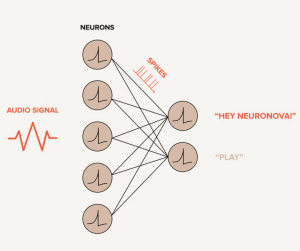
“I would say we make AI chips that work like the human brain, it imitates nature and its millions of years of evolution. Unlike conventional computers that rely on digital bits and precise calculations, the brain processes information analogically through a dense network of neurons and synapses, interpreting the world efficiently while using very little energy.
Our processor does the same for electronic systems, connecting to sensors like microphones, vibration or temperature sensors, and enabling devices to perceive and understand their surroundings. It is the world’s lowest-power AI processor, produced entirely using European chip manufacturing, revitalizing local hardware capabilities while making intelligent devices energy-efficient.”
What were the main difficulties you faced when launching Neuronova? (e.g. difficulty in finding funding, bureaucratic complexities, closed or uncooperative environments) and how did you deal with them?
“The greatest difficulty relates to an endogenous factor: knowing how to constantly question yourself, the classic “don’t fall in love with your own idea”. Gathering feedback is always essential, but even more so in the initial phase. The rest is a corollary of this first point.”
What is the most significant impact that Neuronova’s team is having on the real world?
“We have the world’s lowest-power AI processor, which was a huge victory for the whole team and represents a great starting point rather than a point of arrival. The impact our technology can have been potentially immense: it’s about having the ability to bring intelligence to everything around us. Right now, though, we’re focusing primarily on consumer electronics and enabling new smart devices with native AI that would otherwise be unthinkable. We work closely with large multinationals to integrate our technology and enable the next generation of smart devices: the idea that in a few years there could be a Neuronova chip in all our pockets, on our noses, or in our ears is a real impact that motivates the whole team.”
How important is it, especially in the early stages of a project, to have external support such as TEF to transform an idea or research into something concrete?
“It is essential to have the support of organizations such as TEF to transform an idea into tangible value: training, networking and support are all fundamental elements in finding the right path and asking the right questions: there is no favorable wind for the sailor who does not know where to go. External support is extremely important for breaking all those loops that are created within the company, adding perspectives, instilling doubts and refuting hypotheses, that help that is needed to question oneself.
These realities are equally important in helping people transform from researchers, students or employees into entrepreneurs: technology and people. Within start-ups, founders must not only be researchers, but they must also be entrepreneurs.”
What would you recommend to someone with a brilliant idea but who doesn’t know where to start when launching their start-up?
“Start, even from the wrong place, with the wrong idea, but start. Starting a start-up is an iterative process, involving a large number of trials and errors to converge as quickly as possible on something that the market wants, that is sustainable and that can be transformed into a company with a concrete and significant impact on the world. Without these iterations, the essence of what it means to start a start-up is missing. You miss 100% of the shots you don’t take.”