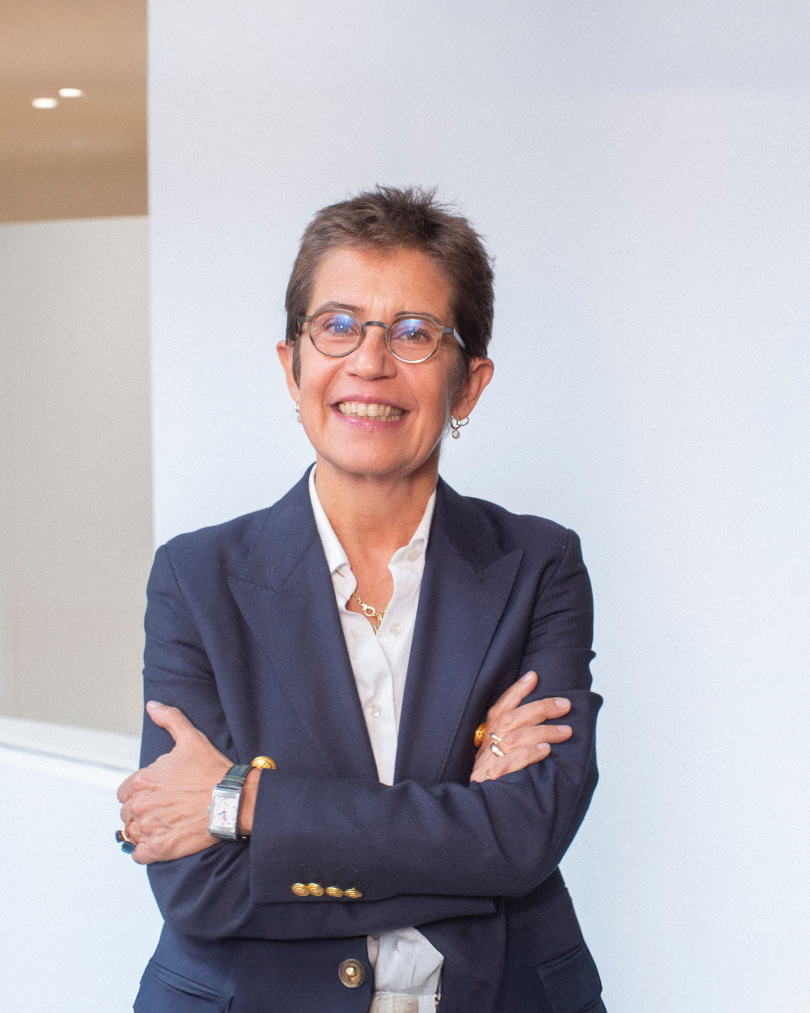
In this interview, Monica de Virgiliis shares her journey from a long career in semiconductors and energy transition to her role as a mentor at the Creative Destruction Lab (CDL). Drawing on executive and board-level experience at companies such as STMicroelectronics, Infineon, Snam, and ASM International, she reflects on innovation, sustainability, and why CDL’s global, problem-driven model is uniquely valuable for founders tackling complex technologies.
What did you study and how this direction in education influences your passion for technology and innovation?
“I studied electronic engineering (microelectronics) at the Politecnico di Torino many years ago. I was fascinated by Moore’s Law and by the idea that a whole sector could be shaped by a human-created law rather than a law of nature. This law worked for 50 years and is now touching its limits at sub-five-nanometer technology, where the limits are physical and cost-related. What fascinates me today is that the same human ingenuity can circumvent this law through new architectures, 3D approaches, and new materials. Bottom line, what fascinates me is breaking rules, even man-defined rules, because that’s where innovation happens.”
After more than 20 years in the semiconductor industry, what sparked your decision to move toward the energy and sustainability sector?
“The reason is that energy is a major bottleneck: the availability of clean, affordable, and secure energy is the bottleneck of engineering systems, including electronic systems. Working in semiconductors, especially in the embedded space, energy efficiency is always one of the top problems, from the chips in your phone onward. This is the connection between the two fields. For me, sustainability means a way of being that is lasting and resilient, where business models are resilient and do not destroy the planet or human society. At a certain point, producing chipsets to sell more phones started to feel limiting.”
What insights have you gained since working as a non-executive/board member?
“After many years as an executive, becoming a non-executive board member allowed me to see the industry from the other side and to complement my chip career across the value chain. Serving with companies like ASM, a leader in atomic layer deposition, and Air Liquide, a leader in advanced compounds, showed me how the same challenges can be solved through equipment, processes, and materials.”
And looking back on your journey, what advice would you give to young professionals at the beginning of their careers?
“The advice I would give to young professionals at the beginning of their careers is to stay hungry, always learn, capture the knowledge of the people you meet, interact with others, and break rules consciously, knowing when and why you are breaking them. Reinvent yourself over time through continuous learning. Breaking the rules is often a requirement for innovation. If you stick to the rules, you do not innovate.”
Talking now about your role as mentor in CDL, why do you think that CDL approach is unique and why should the founder considering joining the program?
“CDL’s uniqueness comes from how global it is and how it is organized by themes. As we saw at the last CDL event, a company raised a specific problem and was immediately connected with another company that has much more experience and has solved similar challenges. This ability to create meaningful connections, combined with the high quality of the people involved, makes the CDL approach truly unique. I am genuinely impressed by how the program is developing.”
Talking about your experience like at the mentor, what it means to you personally and what inspired you to take that role?
“What really drives me is continuous learning. I enjoy meeting people, learning from them, and looking at complex problems from different angles. In that sense, my motivation is a bit selfish, as I want to keep feeding my curiosity. As a positive side effect, I hope to give something back by making my execution experience useful to startups. The global platform that has been created inspires me, as it allows me to meet inventors and scientists. I also hope to contribute some common sense and industry experience, particularly on go-to-market strategies and fundraising.”