How do you develop laser power beaming technology for space and mission-critical applications on Earth? SunCubes, the Italian startup transforming laser energy and data transmission, takes us from the lab to its first real-world deployments.
In the heart of Milan, a group of engineers with an average age of twenty-six are working on a technology that could forever change the way energy and data are transmitted. It’s called SunCubes, and it’s developing systems capable of transferring power and information over long distances using a secure and precise laser beam. We interviewed Federico Ognibene, COO of SunCubes and a mentor in the TEF Ignition program, asking him to tell us how to build a deep-tech start-up that combines science, impact and industrial vision, starting from the acceleration programs at Polihub and thanks also to participation in Switch to Product, the entrepreneurial empowerment programs designed to promote the research projects of the Politecnico di Milano in five Deep Tech verticals.
Who are you and how did SunCubes come about?
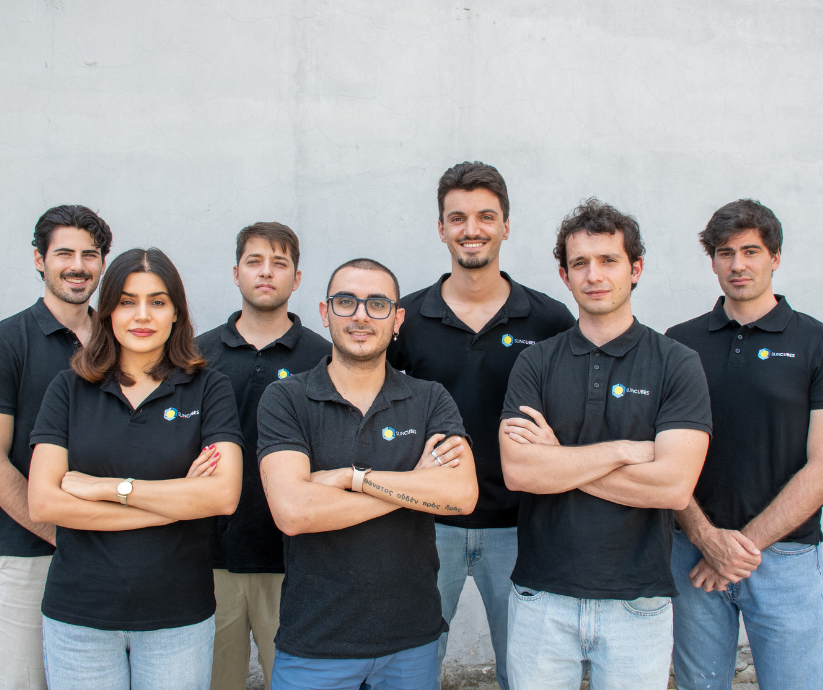
We are a team of five founders – Alberto Chiozzi (CEO), Federico Ognibene (COO), Angelo Lannutti (CCO), Davide Russo (CIO) and Tommaso Aresi (CTO) – with different backgrounds but a shared passion: using technology to solve real-world problems.
SunCubes was founded in 2021, during the third edition of the Italian Space Startup Competition, where we presented our idea for the first time and won first prize. That recognition prompted us to turn the project into a real business and invest immediately in applied research and field validation.”
How would you describe your project to someone unfamiliar with the sector?
SunCubes develops technologies to transmit energy and data over long distances completely wirelessly, using a safe and precise laser beam. This allows systems to be powered in hard-to-reach locations, eliminating the need for cables or physical infrastructure. There are many applications: on Earth, for drones, sensors or surveillance systems; in space, to recharge satellites or future lunar bases. Our goal is to offer a more flexible, reliable and sustainable energy supply that can overcome the limitations of traditional technologies.
What real problem do you want to solve?
“Today, most energy and data transmission infrastructure is still wired. It is a solid model, but one fraught with limitations: long lead times, high costs, vulnerability and poor adaptability in dynamic or hard-to-reach contexts, whether remote environments, crisis areas or space orbits. In an increasingly connected world that is dependent on autonomous systems – from drones to environmental sensors to satellites – the demand for fast, scalable and resilient energy solutions is growing by the day. We want to respond to this challenge.”
What sets you apart from other similar projects?
“Our strength lies in our ability to combine advanced technological research with market vision. We don’t just develop technology in the laboratory: we work closely with partners and potential customers from the outset to validate concrete use cases and quickly achieve product-market fit. Every test and every prototype is created with a specific goal in mind: to solve a real problem and open up a commercial opportunity. We take to the field, literally, bringing technology where it is needed and gathering direct feedback from those who will use it.”
What obstacles did you have to overcome in doing business?
“One of the most difficult steps was learning how to navigate the Italian venture capital landscape. As a deep-tech company, we had to learn how to clearly communicate the value of our solution and its benefits for the customer. At the same time, collaborating with large corporations taught us how to manage timelines and expectations that are very different from those of a start-up, turning every project into a learning opportunity. Today, we can say that every obstacle has also been an accelerator of skills.”
What impact would you like to have on the real world?
“If everything goes as we hope, energy and data could finally travel free from cables. This would mean faster, more resilient and sustainable infrastructure, capable of reaching places that are currently difficult or expensive to serve. Our technologies could enable drones with unlimited autonomy, ensure connectivity in remote areas or support the development of agile space infrastructure.In essence, we want to make energy an accessible service everywhere, without physical limitations.”
A piece of advice for those who have an idea but too many doubts to get started.
“The right time to start is always now. Doubts are part of the process, but they must not become an obstacle. The important thing is to ask for help, discuss and experiment. Every project starts with an idea and the desire to put it into practice: even a small step is already a start. Only by taking action can a brilliant intuition be transformed into something concrete.”